
Banana Freckle response
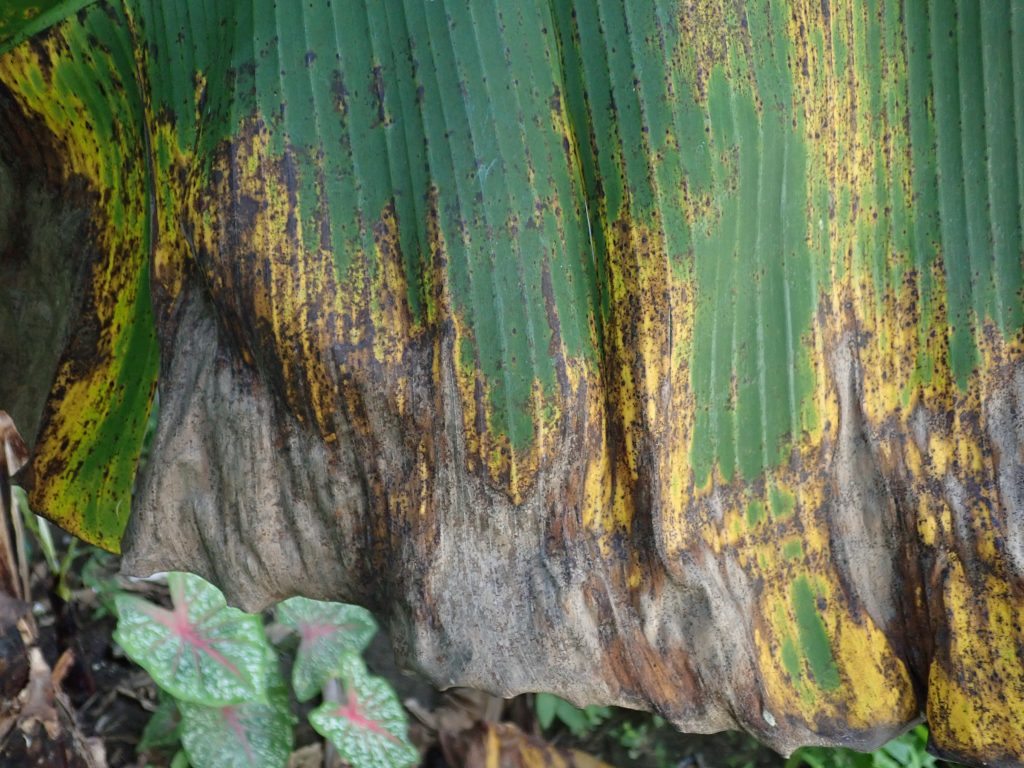
Banana Freckle (Phyllosticta cavendishii) is a serious fungal disease affecting banana plants and fruit.
The Phyllosticta cavendishii strain of banana freckle was first detected on Dwarf Cavendish bananas in the Batchelor – Rum Jungle region of the Northern Territory in May 2022.
The response is now entering a ‘transition to management’ phase which will be supported by official control to help prevent its further spread. This means the rest of Australia is still considered absent of freckle.
This decision has been made by a national committee of affected parties, including government representatives from the Commonwealth, relevant states and territories, Greenlife Industry Australia, and the banana industry. The decision was made based on scientific information that demonstrates eradication is no longer technically feasible.
On this page, growers and banana industry stakeholders will find information relating to the transition but if you have any remaining questions, please reach out to [email protected]
If you suspect you’ve seen Banana Freckle, call the Exotic Plant Pest Hotline on 1800 084 881
The Australian Banana Growers’ Council will keep industry informed as information comes to hand about this new stage of the response. Keep an eye on ABGC communications channels.
- The disease will remain under official control in the Northern Territory. This means the rest of Australia is still considered absent of freckle.
- There are strict measures in place protecting other states and territories. Banana producing states already have strict movement controls in place for banana freckle.
- Banana freckle is currently restricted to a small area of the Northern Territory.
On 10 December 2024, the National Management Group (NMG) agreed that the banana freckle (Phyllosticta cavendishii) response in the NT will transition to the next phase including long-term management of the disease supported by official control requirements.
The decision was made based on scientific information that demonstrates complete eradication was considered not achievable including:
- Evidence pointing to the fact that the current outbreak is most likely a carry-over from the previous outbreak, though there may be other factors.
- The pathogen is challenging to detect and delimit due its cryptic nature and long disease incubation and latency period
On occasions, an exotic plant pest or disease may enter Australia that cannot be eradicated. If this happens, the pest or disease is managed by industry and the government of the state or territory in which it occurs.
When ‘official control’ is applied, the state or territory government puts in place measures to contain and control the pest or disease. These mandatory activities include:
- containment or suppression activities (mostly involves destruction, disposal and decontamination)
- surveillance in the area where the pest or disease could establish
- movement restrictions so the pest or disease does not spread to an area that is not affected.
Official control can be applied at a regional level. In this case, it would apply at the Territory borders so that the rest of Australia will be considered to be absent of freckle.
The banana industry has provided significant financial support to the eradication response through levies, contributing just under 50 per cent of the response funding.
In May 2022 the Northern Territory (NT) Department of Agriculture and Fisheries (NTDAF) responded to an outbreak of banana freckle on commercial and private properties, in a limited area mainly in the Batchelor-Rum Jungle area, around 100km south of Darwin, and in the Girraween-Humpty Doo area, around 35km southeast of Darwin.
Localised detections were found in Middle Point, Marrakai, Fly Creek, Howard Springs, McMinns Lagoon, Herbert, and on Melville Island in the Tiwi Islands. Banana freckle has been confirmed on 142 infected premises (IP). Of these IPs, 2 are commercial banana properties in Rum Jungle and Marrakai.
Banana plants were removed from all IPs in the NT.
More information on response activities for banana freckle is available at https://nt.gov.au/industry/agriculture/food-crops-plants-and-quarantine/banana-freckle
Banana freckle was previously detected on Cavendish bananas in the NT in 2013. A national cost-shared $24 million eradication response ran from 2013-2019. Banana freckle was declared eradicated in 2019, until the current response began in May 2022.
- All infected and suspect properties in the NT have been issued with notices to stop banana fruit and plant material moving off the property.
- NT growers are advised they are not allowed to send any banana fruit or plant material out of the NT without approval.
- Queensland, New South Wales and Western Australia, the commercial banana growing states remain free of banana freckle. There are restrictions and regulations in place that prohibit the entry of banana fruit and/or banana plants and material from the NT into these states.
- Travellers should not take banana fruit, peel, or banana plant material out of the area from which it was purchased in the NT.
- All waste banana fruit, peel and banana plant material should be disposed of in appropriate waste disposal bins and should not be discarded onto the ground or on other plants.
- Always check the Australian Interstate Quarantine website before travelling across borders.
- A revised response plan is being developed by the Consultative Committee for Emergency Plant Pests (CCEPP) and the NT is operating under an interim strategy to monitor and manage banana freckle.
- Previously, the National Management Group (NMG) endorsed an updated version of the National Banana Freckle Response Plan on 9 February 2023, which allows for response activities to be cost-shared under national arrangements, including owner reimbursement costs.
- Plant Health Australia has further information on owner reimbursement costs under the Emergency Plant Pest Response Deed.
- NTDAF is working closely with the banana and nursery industries, the Australian Government Department of Agriculture, Fisheries and Forestry (DAFF) and state and territory governments under national emergency response arrangements. There are also public awareness activities underway to encourage residents to send in photos of their banana plants and report any signs of the disease.
- In addition, NTDAF is working with DAFF to upskill Indigenous rangers on the Tiwi Islands in banana freckle identification, surveillance, and biosecurity decontamination protocols.
Visit abgc.org.au/banana-freckle to learn more about banana freckle and how to spot it.
Bananas are still safe to consume.
More information on banana freckle and the response can be found on the following pages: