
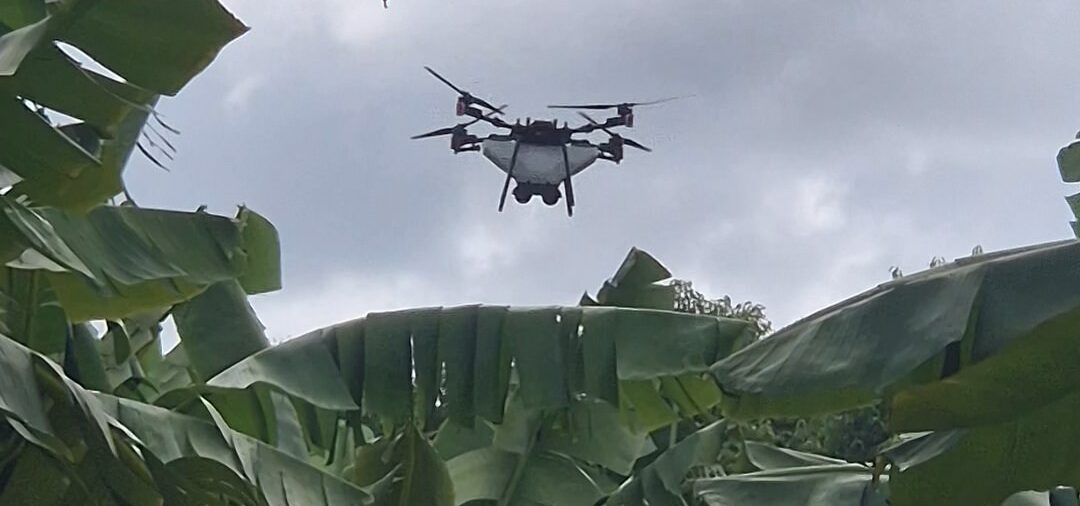
DPI researchers have recently been exploring a new approach to managing spider mites by using drones to release beneficial predatory mites directly and efficiently into banana production systems.
Spider mites can build rapidly in bananas during hot, dry conditions, causing leaf bronzing and reduced plant performance. Management can also be challenging where repeated chemical use increases the risk of resistance, prompting interest in alternative approaches.
With growers increasingly looking toward integrated pest and disease management (IPDM), this trial investigated whether aerial releases of the predatory mite Neoseiulus californicus (Californicus) could provide a practical new tool for banana production systems.
The idea is simple: instead of relying solely on ground-based applications of chemicals, drones can distribute beneficial insects quickly and evenly across a block, potentially improving coverage while reducing labour requirements and crop disturbance.
Conditions leading into the trial were favourable for spider mite development; however, rainfall increased significantly following predator release. This rise in rainfall suppressed spider mite populations across the site, meaning predator performance could not be fully assessed under outbreak conditions. The combination of predators and rain contributed to a ~60% reduction in the abundance of spider mite eggs and nymphs, and 40% reduction of adults. Despite this, the drone releases proved efficient and well-suited to banana production systems, providing valuable operational insights into aerial deployment within a commercial system.
Encouragingly, the trial demonstrated that drone delivery is a feasible way to introduce beneficial mites into bananas, opening the door for future biological control programs within IPDM systems. As technology continues to develop, aerial release may become a practical option for large-scale deployment, particularly where access is difficult or rapid response is needed.
Additional trials are planned to better understand how predatory mites establish and suppress populations in commercial banana systems. Although still in the early days, this work highlights ongoing efforts to investigate new tools that support sustainable pest management and provide growers with more options in the future.
Thanks to Cassowary Coast Drones, for providing drone application services and Bugs for Bugs ® for supplying predatory mites for this trial.


This project has been funded by Hort Innovation using the banana research and development levy and funds from the Australian Government. For more information on the fund and strategic levy investment visit horticulture.com.au.