
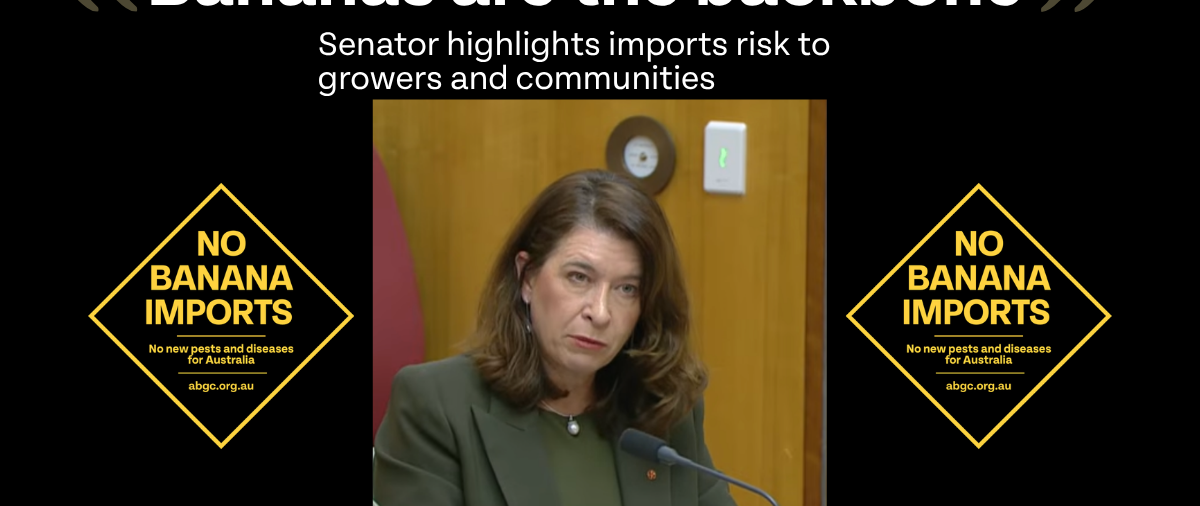
In a pointed exchange at the Senate Rural and Regional Affairs and Transport Legislation Committee, Senator Susan McDonald pressed representatives from the Department of Agriculture, Fisheries and Forestry (DAFF) about the biosecurity risks associated with imports from the Philippines affecting Australia’s banana industry. While highlighting the imports risk to growers and communities, she delivered a key message that bananas are ‘the backbone of Australia’s food sovereignty’.
Below are some of the key questions asked within the exchange along with the Department’s responses.
- Did the delegation that travelled to the Philippines as part of the imports risk assessment include an industry-approved banana expert?
The Senator had previously requested that an independent expert approved by industry be included. This was a request also raised directly by the ABGC and the Banana Imports Committee to DAFF. Officials confirmed this happened, with a banana production agronomist from Queensland’s Department of Primary Industries selected in consultation with the banana growing industry, and feedback on the selection was “very positive”, according to DAFF.
- Will another Philippines visit be needed?
Officials said they now have sufficient on-ground observations to complete the draft risk analysis report, so no further visits are planned at this stage.
- Should imports progress and a disease incursion result, will the government pay for eradication?
DAFF representatives stated the goal of the biosecurity framework is to ensure any import pathway maintains Australia’s high biosecurity standards and keeps risk “as close to zero as possible.”
If an incursion were to occur, DAFF explained that existing national cost-sharing arrangements would apply, meaning governments and industry would jointly respond to the outbreak.
Senator McDonald pushed back strongly on this point, highlighting growers’ concerns that they could again be left carrying major financial burdens similar to previous disease eradication efforts. This would not be acceptable.
- Has it been decided whether to use a regulated Biosecurity Imports Risk Analysis (BIRA) process or not?
DAFF confirmed the decision is still under consideration, with a determination expected in the coming weeks. They noted that a BIRA process would include:
- Greater transparency
- Independent scientific advisory input
- Opportunities for stakeholder review
- Oversight from the Inspector-General of Biosecurity
- What economic analysis is the Australian Bureau of Agricultural and Resource Economics and Sciences (ABARES) doing?
ABARES has been engaged to model the economic impact of various banana diseases. Senator McDonald pushed for the scope to go beyond just bananas, to include the broader value of the industry to regional trucking, backhauling, and agricultural infrastructure across northern Australia. DAFF took that comment on notice.
The hearing reinforced the importance of Australia’s banana industry as Senator McDonald said in her closing comment: “Bananas are the backbone of Australia’s food sovereignty.”
Additional questions were asked in the exchange. You can view Senator McDonald’s questions at Senate Estimates here.
Alternatively, a transcript of the exchange is here.
To contribute to the Banana Imports Fighting Fund, click here, https://abgc.org.au/banana-imports-fighting-fund/.
If you have any questions or points you’d like the Committee to hear about, contact [email protected].