
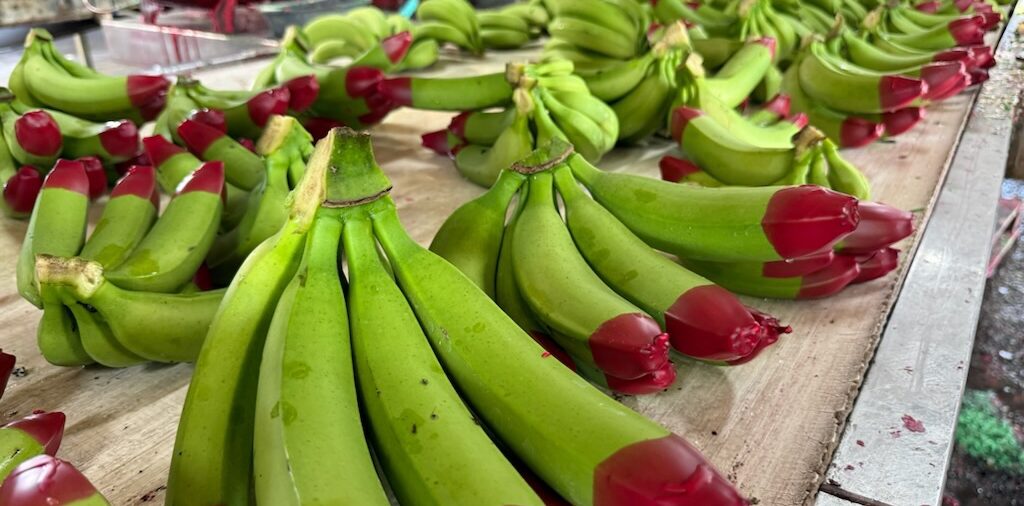
The Far North Queensland family business behind the distinctive Red Tip Eco Banana is taking the point of difference into Japan, as Pacific Coast Eco Bananas builds its next major export opportunity.
Founders Frank and Dianne Sciacca said the small red tip on the end of their bananas represented a much bigger story: a family farming system developed near Innisfail, built on Far North Queensland’s own ecosystem, premium soil health and biodiversity.
The system was born from Frank’s belief that farming needed to work with nature, not against it.
“The lightbulb moment for me was diving in Great Barrier Reef, you could see the whole ecosystem working together,” Frank said.
“When parts of the reef started to die, everything changed. I came home, looked at the farm and thought, this is like the reef. My farm has an ecosystem as well.”
After years of testing and refinement, that lightbulb moment eventually became the Ecoganic system, a production approach designed around soil health, biodiversity and reducing chemical inputs.
“Developed around nature, it was like a big puzzle, watching what the insects, grasses, weeds and soil were doing, then putting it all together,” Frank said.
But to make the system meaningful to consumers, the business needed a marker people could instantly recognise.
“The red tip had to get attention, and it worked because everybody asked why. It was a real conversation starter,” Frank said.
That conversation has now reached Japanese buyers and consumers with Pacific Coast Eco Bananas testing the market, including supply chain pathways, product quality and customer response.
“We always saw Japan as a market that could give us the growth. It’s a very health-conscious market, and there is an appreciation for product differentiation,” Dianne said.
Dianne said the opportunity was not just about exporting bananas, but taking a clearly identifiable, premium Queensland product into a market that values provenance, and how food is produced.
“What’s exciting about Japan is the interest is not only in our bananas, but in our growing system, the quality and the broader story behind the produce,” she said. Japan has also opened potential opportunities beyond traditional retail and export, including pet care, pharmaceutical, beauty, and health-focused product development.
The Japanese opportunity also required the business to solve one of the toughest challenges for fresh produce exporters: getting bananas from Far North Queensland to market without compromising quality.
Dianne said the business with the help of the Queensland Department of Primary Industries and research partners had invested significant time in understanding temperature control, transport conditions and supply chain risks, while the ability to export through Cairns Airport had helped reduce one leg of the journey from Far North Queensland to international markets.
Pacific Coast Eco Bananas also worked with Trade and Investment Queensland (TIQ) to support its Japanese market development, including through trade activity, market introductions and the Market Accelerator Program.
“TIQ helped identify potential customers for us in and all of those connections have really kickstarted this journey again for us,” Dianne said.
“They give small businesses the opportunity to put their product before the eyes of the world.”
Their story follows TIQ’s recent Queensland Exporter Regional Roadshow in Cairns, which helped regional businesses understand export opportunities, market readiness and the support available to take Queensland products overseas.
For Frank and Dianne, Japan is not about going away from Australian customers or domestic business. It’ about creating a new growth pathway for the business and, potentially, for more Far North Queensland farmers.
“This is not about taking focus away. This is about growth for the region,” Dianne said.
Pacific Coast Eco Bananas currently works in partnership with multiple family-owned banana farms across more than 1,000 acres in Far North Queensland and supports regional employment and value-added agricultural production.
Frank said seeing their bananas and farming system developed on family farms near Innisfail gain recognition overseas showed what regional Queensland businesses could achieve.
“Not all innovation comes from big corporates,” Frank said.
“It’s a big thing for Australia, and it came from a family farm. There are a lot of little individuals doing fantastic work, and they need recognition and support.”